Can an ill-fated Dane demonstrate how technology stimulates the brain?
On Friday mornings at Basler Library, Northeast State faculty and tutors host Anatomy & Physiology and Biology course study sessions for students. Dedicated students spend their Friday mornings with instructors and tutors breaking down the complex relationships of the human body and biology.
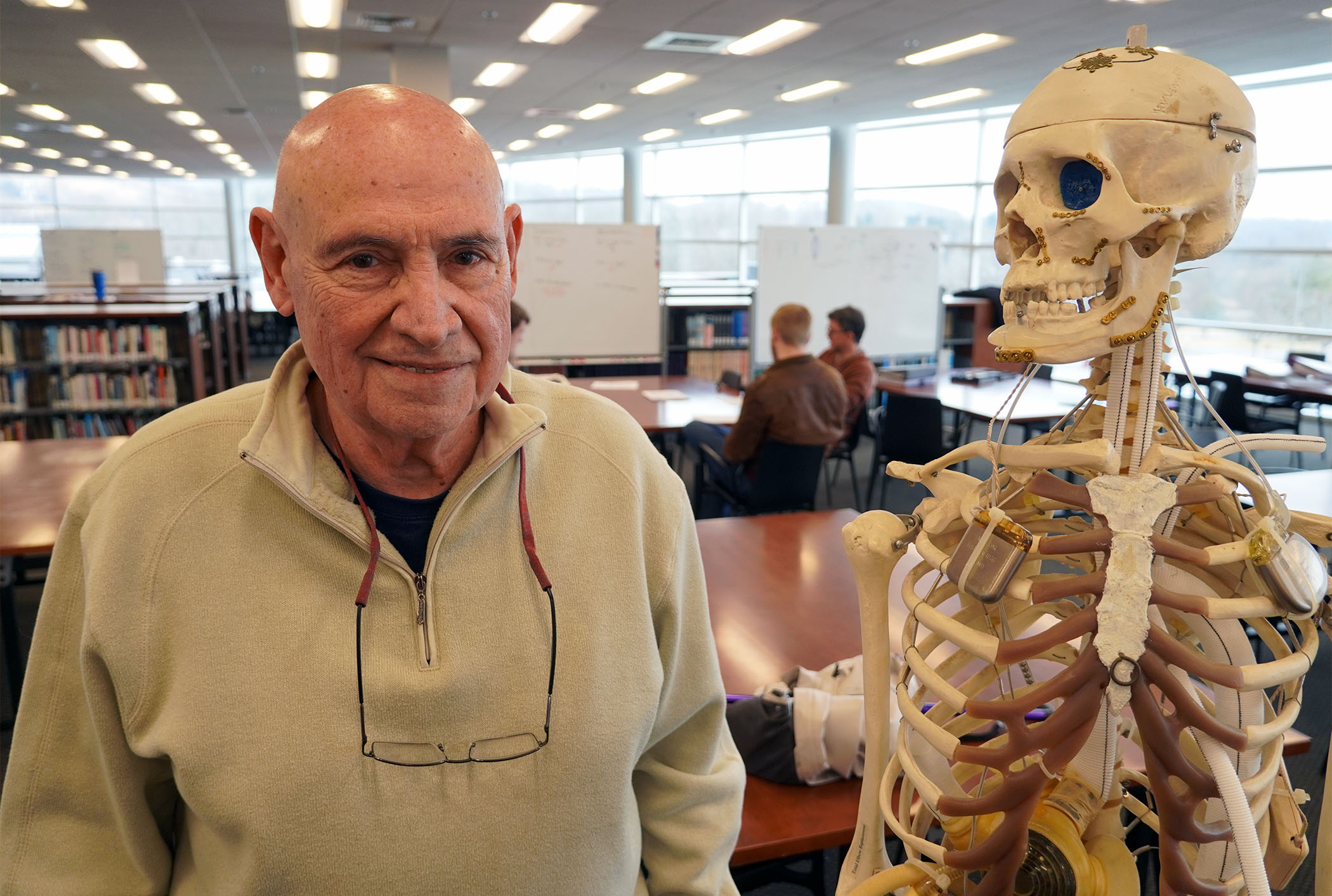
This semester a new visitor showed up with a name suggesting he was on loan from the Humanities Division. “Hamlet” is one of three adult skeletons outfitted with a variety of medical device equipment used to help the body function. He now attends the Friday study sessions at Basler Library.
“We did not have a full-size teaching skeleton for tutoring lab,” said Chris Hitechew, dean of the Science division at Northeast State. “There are only three of these, and we’re proud to have one of them.”
Hamlet features several pieces of medical hardware used to repair the human body. From knee replacements to brain waves, the teaching model dives beneath the muscle and skin to give students a glimpse into the human anatomy. Engineer and retired adjunct professor Edward Mueller donated Hamlet to Northeast State during the winter break.
“I taught a class regularly on biomaterials where we used the skeletons,” said Mueller, an electrical / biomedical engineer whose career reads like a history of biomedical technology in the United States. “I had kids in my class putting devices on the skeleton.”
The first skeleton named Yorick became the prototype developed by Mueller and outfitted by students he taught at Johns Hopkins University in Baltimore. The later renditions of Hamlet and Ophelia rounded out the trio with the newest devices being added to those dry bones.
Hamlet on the job in Basler Library.
Hamlet’s make-up includes knee, hip, and elbow replacements; a cochlear implant; a digital pacemaker used for cardiac patients; and a digital brain stimulator used to treat neural disorders such as epilepsy. The model includes a Jarvik artificial heart developed by the renowned Dr. Robert Jarvik during the 1980s.
“All these medical implants were studied and installed by students,” said Mueller. “The skeletons Hamlet and Ophelia were built by students in my class.”
Mueller donated the Ophelia model to the Hands-On Regional Museum in Johnson City. Alas, poor Yorick was commandeered by Smithsonian officials as a piece of technological history. He now makes his home in the Museum of American History, as Mueller last heard.
An Air Force veteran, he completed his graduate work in engineering at George Washington University. He found himself drawn to medicine specifically biomedical engineering and holography. Prior to biomedical engineering becoming a must-have department at universities far and wide, he found his way to the Seton Hall University Medical School in New Jersey. There the medical professors were intrigued by his suggestions on using engineering in medical education.
He was in Washington, D.C., when he learned the National Institute of Health was starting the medical device evaluation program for the U.S. Food and Drug Administration (FDA). These early years found Mueller developing the classification data system to identify the proliferating number of medical devices the FDA was charged with regulating. These devices ran the gamut from a tongue depressor to a heart valve.
While working with the FDA, Mueller spent 27 years as an adjunct faculty member at Johns Hopkins. There, he taught engineering applications to students for the medical and biomaterials fields.
Medical technology devices turn up in an enormous segment of the population. Hitechew recalled a class he taught several years back with a student who had a cochlear implant. While the implant technology at the time was solid for the time, the implant presented challenges for the recipient to hear certain sounds.
“She couldn’t use a regular stethoscope, because that cochlear implant didn’t translate that sound,” Hitechew said.
Fortunately, the legendary and now-retired Betty Mask from Northeast State’s Accessibility Services acquired a digital stethoscope used to serve the student.
Mueller’s work contributed to myriad advances of biomedical technology into the modern age. As the technology continues to change, the future of biomedical engineering shifts from hardware to tissue replacement.
“Your system is in a state of dynamic equilibrium; that is hard to recreate with a part like a stainless steel or chrome polymer replacement,” said Mueller. “The limitation with a lot of technology you see on the skeleton is, it works best the first day you have it implanted; it degrades from that moment on.”
The human body rebuilds itself at the cellular level. Bones and organs regenerate daily throughout the life of a human being. The next step for biomedical treatment involves engineering human tissue to replace damaged bones, soft tissues, and even organs with improved versions created from a patient’s own cells.
While that proposition reads like a Ray Bradbury novel, Mueller said biomedical technology trends much closer to reality than one can imagine.
“Where this is all going is guided tissue replacement,” he said. “The nice part is, we will be taking your cells and growing them to replace the tissue so we don’t have rejection issues.”
Anatomy and Physiology I and II along with Introduction to Microbiology serve as the core courses for Northeast State students pursuing associate of applied science degrees and technical certificates in Health Professions and important courses in many Science programs. The Friday study sessions are open from 9:00 a.m. to 11:00 a.m. on the third floor of Wayne G. Basler Library.
“The great thing about Hamlet is students can see beyond what the textbook talks about,” said Hitechew. “Even when an instructor doesn’t get to all the materials in lecture, they can pick up and talk about those subjects at the tutoring sessions.”

Can an ill-fated Dane demonstrate how technology stimulates the brain?
On Friday mornings at Basler Library, Northeast State faculty and tutors host Anatomy & Physiology and Biology course study sessions for students. Dedicated students spend their Friday mornings with instructors and tutors breaking down the complex relationships of the human body and biology.
This semester a new visitor showed up with a name suggesting he was on loan from the Humanities Division. “Hamlet” is one of three adult skeletons outfitted with a variety of medical device equipment used to help the body function. He now attends the Friday study sessions at Basler Library.
“We did not have a full-size teaching skeleton for tutoring lab,” said Chris Hitechew, dean of the Science division at Northeast State. “There are only three of these, and we’re proud to have one of them.”
Hamlet features several pieces of medical hardware used to repair the human body. From knee replacements to brain waves, the teaching model dives beneath the muscle and skin to give students a glimpse into the human anatomy. Engineer and retired adjunct professor Edward Mueller donated Hamlet to Northeast State during the winter break.
“I taught a class regularly on biomaterials where we used the skeletons,” said Mueller, an electrical / biomedical engineer whose career reads like a history of biomedical technology in the United States. “I had kids in my class putting devices on the skeleton.”
The first skeleton named Yorick became the prototype developed by Mueller and outfitted by students he taught at Johns Hopkins University in Baltimore. The later renditions of Hamlet and Ophelia rounded out the trio with the newest devices being added to those dry bones.
Hamlet’s make-up includes knee, hip, and elbow replacements; a cochlear implant; a digital pacemaker used for cardiac patients; and a digital brain stimulator used to treat neural disorders such as epilepsy. The model includes a Jarvik artificial heart developed by the renowned Dr. Robert Jarvik during the 1980s.
“All these medical implants were studied and installed by students,” said Mueller. “The skeletons Hamlet and Ophelia were built by students in my class.”
Mueller donated the Ophelia model to the Hands-On Regional Museum in Johnson City. Alas, poor Yorick was commandeered by Smithsonian officials as a piece of technological history. He now makes his home in the Museum of American History, as Mueller last heard.
An Air Force veteran, he completed his graduate work in engineering at George Washington University. He found himself drawn to medicine specifically biomedical engineering and holography. Prior to biomedical engineering becoming a must-have department at universities far and wide, he found his way to the Seton Hall University Medical School in New Jersey. There the medical professors were intrigued by his suggestions on using engineering in medical education.
He was in Washington, D.C., when he learned the National Institute of Health was starting the medical device evaluation program for the U.S. Food and Drug Administration (FDA). These early years found Mueller developing the classification data system to identify the proliferating number of medical devices the FDA was charged with regulating. These devices ran the gamut from a tongue depressor to a heart valve.
While working with the FDA, Mueller spent 27 years as an adjunct faculty member at Johns Hopkins. There, he taught engineering applications to students for the medical and biomaterials fields.
Medical technology devices turn up in an enormous segment of the population. Hitechew recalled a class he taught several years back with a student who had a cochlear implant. While the implant technology at the time was solid for the time, the implant presented challenges for the recipient to hear certain sounds.
“She couldn’t use a regular stethoscope, because that cochlear implant didn’t translate that sound,” Hitechew said.
Fortunately, the legendary and now-retired Betty Mask from Northeast State’s Accessibility Services acquired a digital stethoscope used to serve the student.
Mueller’s work contributed to myriad advances of biomedical technology into the modern age. As the technology continues to change, the future of biomedical engineering shifts from hardware to tissue replacement.
“Your system is in a state of dynamic equilibrium; that is hard to recreate with a part like a stainless steel or chrome polymer replacement,” said Mueller. “The limitation with a lot of technology you see on the skeleton is, it works best the first day you have it implanted; it degrades from that moment on.”
The human body rebuilds itself at the cellular level. Bones and organs regenerate daily throughout the life of a human being. The next step for biomedical treatment involves engineering human tissue to replace damaged bones, soft tissues, and even organs with improved versions created from a patient’s own cells.
While that proposition reads like a Ray Bradbury novel, Mueller said biomedical technology trends much closer to reality than one can imagine.
“Where this is all going is guided tissue replacement,” he said. “The nice part is, we will be taking your cells and growing them to replace the tissue so we don’t have rejection issues.”
Anatomy and Physiology I and II along with Introduction to Microbiology serve as the core courses for Northeast State students pursuing associate of applied science degrees and technical certificates in Health Professions and important courses in many Science programs. The Friday study sessions are open from 9:00 a.m. to 11:00 a.m. on the third floor of Wayne G. Basler Library.
“The great thing about Hamlet is students can see beyond what the textbook talks about,” said Hitechew. “Even when an instructor doesn’t get to all the materials in lecture, they can pick up and talk about those subjects at the tutoring sessions.”
Share this:
Like this: