Dr. Caitlin Chapman has been appointed as Dean of the Division of Humanities at Northeast State Community College.
In 2010, Chapman started working for Northeast State as a division instructor. She spent three years as an adjunct lecturer teaching dual enrollment courses before joining the faculty full-time in 2013.
“Students bring so many rich experiences to every class,” said Chapman. “It is not unusual to have a class with dual enrollment students and also sixty-year-old, non-traditional students in the same classroom.”
Chapman served as an associate professor in the division prior to being appointed dean. She holds a bachelor’s degree and a master’s degree in English from East Tennessee State University (ETSU). She holds a doctorate in Education from ETSU.
Chapman credited her mother as the catalyst for her drive to become an English professor. As a kindergarten student, Chapman said she shed a few tears on her way to school. Her mom worked out a reward system that paid off for everyone.
“My mom told me, ‘If you go all week and don’t cry, we will go to the library on Friday,’” she said. “That is the recipe for an English major apparently, she was always reading, and I was always reading as a kid.”
In high school, Chapman pushed herself academically by enrolling in advanced mathematics and calculus courses. She described how Betty Burley, a “saint of a math teacher,” helped her get through it. She enrolled at ETSU with a legal studies and history minor and an English major.
The division of the humanities includes the academic programs of art, digital media, English, foreign language, history, humanities, music, philosophy, and theater. The Humanities division features 30 full-time faculty members and approximately 40 adjunct faculty members for the upcoming fall semester. These faculty teach hundreds of courses and contact students across the college’s academic spectrum.
“We see almost every student that attends Northeast State,” said Chapman. “Everybody experiences at least one humanities class.”
Chapman taught as an adjunct instructor at Northeast State beginning in 2010 shortly after completing her master’s degree. She joined the college as a full-time instructor in 2013. She taught English courses to dual enrollment classes at six different high schools around the Northeast State service area.
“I love to see those dual enrollment students I taught there and see them again at graduation,” said Chapman. “I hope through dual enrollment classes they saw what Northeast State had to offer.”
Chapman recalled teaching night classes with students who were nurses, welders, masons, and stay-at-home moms. Those students enrolled for different reasons but found their way into a humanities class. Their experiences presented unique ways to interpret literature and art.
“Having that diverse group of voices in a classroom helps us understand the literature in a different way,” she said.
Chapman praised the division’s faculty and staff. She is excited about the music department’s renewed efforts to engage students with experience in chorus or playing musical instruments. She also praised the new digital media program as an exciting new major for students combining art and technology. The program is designed to transfer to ETSU’s four-year degree program in digital media.
In the age of technological advancement, Chapman sees the role of the humanities as more important than ever to emphasize the human experience. While artificial intelligence grabs headlines and clicks, our individual humanity underpins the structure of civilization.
“The study of human nature and humanity is what we need to keep us separate from AI,” she said. “AI cannot replace a description of human emotions; humanities subjects like art, literature, history, and philosophy help people think about human problems and help us innovate solutions to human problems.”
Chapman rebranded the popular phrase “soft skills” as “durable skills” needed in every profession. The study of the humanities develops the ability to communicate, to think critically, and to determine the legitimacy of information read and shared. She noted students need those durable skills reflected in every major.
A native of Greene County, Chapman ranks the literature of Appalachia as her favorite genre. While the beauty of literature about distant lands compels the imagination, Chapman said the literature of one’s home resonated in the reader’s heart.
“There is something about bringing it close to home that changes the experience because you recognize the characters in the books,” she said. “Seeing the place that I call home reflected in books that are being read by everybody is a neat experience.”

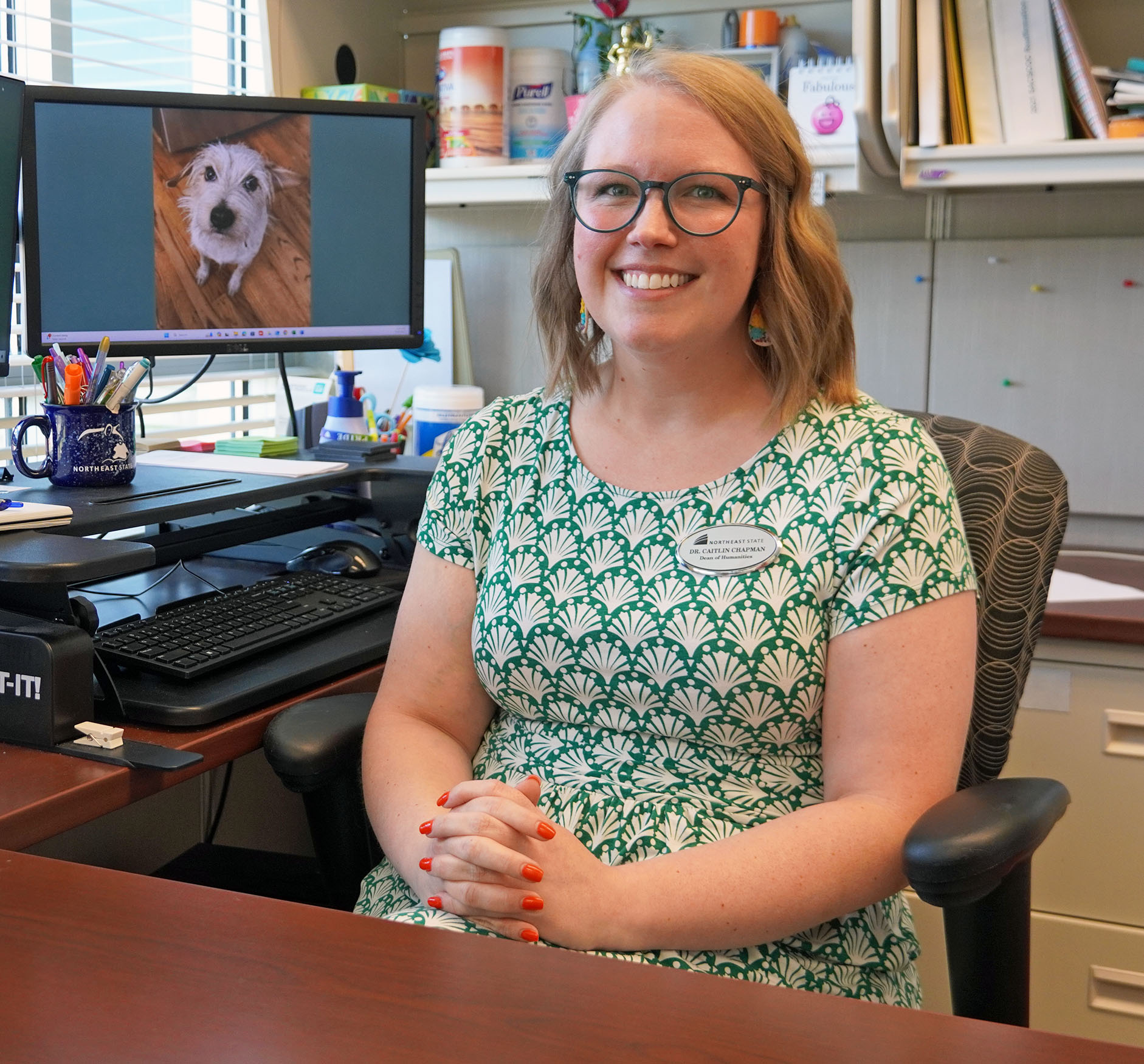
Dr. Caitlin Chapman has been appointed as Dean of the Division of Humanities at Northeast State Community College.
In 2010, Chapman started working for Northeast State as a division instructor. She spent three years as an adjunct lecturer teaching dual enrollment courses before joining the faculty full-time in 2013.
“Students bring so many rich experiences to every class,” said Chapman. “It is not unusual to have a class with dual enrollment students and also sixty-year-old, non-traditional students in the same classroom.”
Chapman served as an associate professor in the division prior to being appointed dean. She holds a bachelor’s degree and a master’s degree in English from East Tennessee State University (ETSU). She holds a doctorate in Education from ETSU.
Chapman credited her mother as the catalyst for her drive to become an English professor. As a kindergarten student, Chapman said she shed a few tears on her way to school. Her mom worked out a reward system that paid off for everyone.
“My mom told me, ‘If you go all week and don’t cry, we will go to the library on Friday,’” she said. “That is the recipe for an English major apparently, she was always reading, and I was always reading as a kid.”
In high school, Chapman pushed herself academically by enrolling in advanced mathematics and calculus courses. She described how Betty Burley, a “saint of a math teacher,” helped her get through it. She enrolled at ETSU with a legal studies and history minor and an English major.
The division of the humanities includes the academic programs of art, digital media, English, foreign language, history, humanities, music, philosophy, and theater. The Humanities division features 30 full-time faculty members and approximately 40 adjunct faculty members for the upcoming fall semester. These faculty teach hundreds of courses and contact students across the college’s academic spectrum.
“We see almost every student that attends Northeast State,” said Chapman. “Everybody experiences at least one humanities class.”
Chapman taught as an adjunct instructor at Northeast State beginning in 2010 shortly after completing her master’s degree. She joined the college as a full-time instructor in 2013. She taught English courses to dual enrollment classes at six different high schools around the Northeast State service area.
“I love to see those dual enrollment students I taught there and see them again at graduation,” said Chapman. “I hope through dual enrollment classes they saw what Northeast State had to offer.”
Chapman recalled teaching night classes with students who were nurses, welders, masons, and stay-at-home moms. Those students enrolled for different reasons but found their way into a humanities class. Their experiences presented unique ways to interpret literature and art.
“Having that diverse group of voices in a classroom helps us understand the literature in a different way,” she said.
Chapman praised the division’s faculty and staff. She is excited about the music department’s renewed efforts to engage students with experience in chorus or playing musical instruments. She also praised the new digital media program as an exciting new major for students combining art and technology. The program is designed to transfer to ETSU’s four-year degree program in digital media.
In the age of technological advancement, Chapman sees the role of the humanities as more important than ever to emphasize the human experience. While artificial intelligence grabs headlines and clicks, our individual humanity underpins the structure of civilization.
“The study of human nature and humanity is what we need to keep us separate from AI,” she said. “AI cannot replace a description of human emotions; humanities subjects like art, literature, history, and philosophy help people think about human problems and help us innovate solutions to human problems.”
Chapman rebranded the popular phrase “soft skills” as “durable skills” needed in every profession. The study of the humanities develops the ability to communicate, to think critically, and to determine the legitimacy of information read and shared. She noted students need those durable skills reflected in every major.
A native of Greene County, Chapman ranks the literature of Appalachia as her favorite genre. While the beauty of literature about distant lands compels the imagination, Chapman said the literature of one’s home resonated in the reader’s heart.
“There is something about bringing it close to home that changes the experience because you recognize the characters in the books,” she said. “Seeing the place that I call home reflected in books that are being read by everybody is a neat experience.”
Share this:
Like this: