A newly designed instructional space at Northeast State’s Regional Center for Advanced Manufacturing (RCAM) puts students in control.
RCAM staff and faculty unveiled a newly consolidated operational control room at its Kingsport site during an open house event on Friday. The control room combines teaching resources previously deployed in several different classrooms to provide efficient instruction for operational control students.
“We were able to consolidate all the teaching tools in one room,” said Blake Montgomery, Executive Director of Economic & Workforce Development at RCAM. “It really prepares the students for what they will see when they get on the job.”
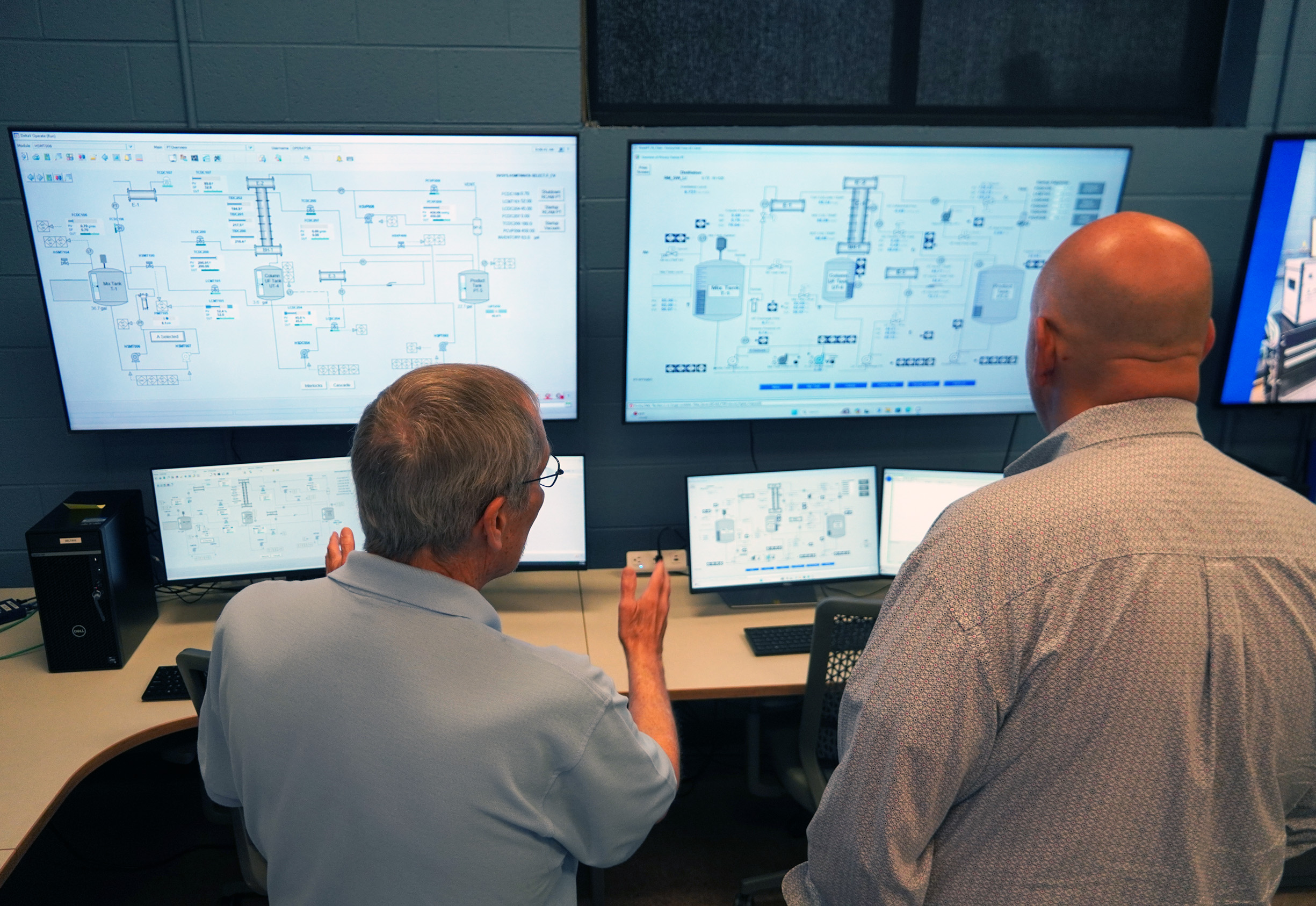
The control center features multiple monitor stations and screens that simulate piping and liquid flow processes within a chemical process facility. One monitor serves as the real control monitoring system for a chemical distillation unit located outside the RCAM building. That distillation unit’s pipes and tanks are outfitted with program logic controllers (PLC). The PLC sensors transmit the physical plant’s system details to computer software within the control room’s digital control board. The PLC transmitters detect the liquid flow and temperature.
“An operator can sit at a control station and have an overview of all the process in front of him,” said Jack Rutherford, instructor and a program director at RCAM. “You can monitor valves, pumps, flows, and pressures from one central location.”
Industrial operations centers and control rooms often operate 24 hours a day, seven days a week and depend on unique equipment. Students who become operators manage a large network of industrial processes across an entire facility. The control room’s software system detects liquid flow and temperature, valve and pump status, and alerts operators to any problems.
Students attending classes at RCAM began using the control room teaching systems during the past spring semester. The training module allowed each student to operate his or her own plant facility. That module introduced students to monitoring and troubleshooting issues within the system. RCAM instructors created different real world scenarios students could face on the job. Instructors praised the new room as a platform of learning for future operators.
“There are many benefits to a control room,” said Rutherford. “One, it puts operators in a safe environment; it also allows the operator control of a wider span of processes over a distance across the plant.”
A new instruction space at RCAM gives students a foundation as control room operators for industries.
Industries once stationed multiple employees inside a production facility to monitor operations and identify problems. Technological advancements in sensors and microchips now measure production movements to the smallest temperature and fluid ounce. The control room operator monitors the sensor network across the facility for efficiency and problems.
The new control room monitors a small glass still platform used to demonstrate the making of ethanol. The teaching tool mimics a large industrial column often used in the chemical industry for distillation or the extraction of substances in production. A simulated digital column gives students the opportunity to view the analytic measures of the column.
“This teaches students what a column looks like inside if you could see the vapor and liquid separation,” said Sam Browder, lab instructor at RCAM. “The digital control system allows students to change control set points and outputs; we can program problems within the system the students must identify and manage as control room operators.”
Browder explained how the chemical ethanol had a lower boiling point than water making it easier to separate and capture during the distillation process. Two products can be made within a column depending on the distillation process and chemicals being sought to capture, he said.
The room features CAD-created blueprints of processes used to build the physical chemical process system and digital monitoring system. Those blueprints give students the engineering design of the plant’s production processes.
The control room’s creation was funded through the federal Higher Education Emergency Relief Funding grant. This cutting-edge facility enhances how operator apprenticeship program students learn to operate production equipment remotely. The grant also enabled RCAM to acquire new equipment, computers, and software, taking the classroom experience to the next level. Acquiring the software equipment, computers, and monitors took several months to put together, Montgomery said.
To learn more about the opportunities available to individuals and companies, visit the RCAM website at https://manufacturingfuture.net/.

A newly designed instructional space at Northeast State’s Regional Center for Advanced Manufacturing (RCAM) puts students in control.
RCAM staff and faculty unveiled a newly consolidated operational control room at its Kingsport site during an open house event on Friday. The control room combines teaching resources previously deployed in several different classrooms to provide efficient instruction for operational control students.
“We were able to consolidate all the teaching tools in one room,” said Blake Montgomery, Executive Director of Economic & Workforce Development at RCAM. “It really prepares the students for what they will see when they get on the job.”
The control center features multiple monitor stations and screens that simulate piping and liquid flow processes within a chemical process facility. One monitor serves as the real control monitoring system for a chemical distillation unit located outside the RCAM building. That distillation unit’s pipes and tanks are outfitted with program logic controllers (PLC). The PLC sensors transmit the physical plant’s system details to computer software within the control room’s digital control board. The PLC transmitters detect the liquid flow and temperature.
“An operator can sit at a control station and have an overview of all the process in front of him,” said Jack Rutherford, instructor and a program director at RCAM. “You can monitor valves, pumps, flows, and pressures from one central location.”
Industrial operations centers and control rooms often operate 24 hours a day, seven days a week and depend on unique equipment. Students who become operators manage a large network of industrial processes across an entire facility. The control room’s software system detects liquid flow and temperature, valve and pump status, and alerts operators to any problems.
Students attending classes at RCAM began using the control room teaching systems during the past spring semester. The training module allowed each student to operate his or her own plant facility. That module introduced students to monitoring and troubleshooting issues within the system. RCAM instructors created different real world scenarios students could face on the job. Instructors praised the new room as a platform of learning for future operators.
“There are many benefits to a control room,” said Rutherford. “One, it puts operators in a safe environment; it also allows the operator control of a wider span of processes over a distance across the plant.”
Industries once stationed multiple employees inside a production facility to monitor operations and identify problems. Technological advancements in sensors and microchips now measure production movements to the smallest temperature and fluid ounce. The control room operator monitors the sensor network across the facility for efficiency and problems.
The new control room monitors a small glass still platform used to demonstrate the making of ethanol. The teaching tool mimics a large industrial column often used in the chemical industry for distillation or the extraction of substances in production. A simulated digital column gives students the opportunity to view the analytic measures of the column.
“This teaches students what a column looks like inside if you could see the vapor and liquid separation,” said Sam Browder, lab instructor at RCAM. “The digital control system allows students to change control set points and outputs; we can program problems within the system the students must identify and manage as control room operators.”
Browder explained how the chemical ethanol had a lower boiling point than water making it easier to separate and capture during the distillation process. Two products can be made within a column depending on the distillation process and chemicals being sought to capture, he said.
The room features CAD-created blueprints of processes used to build the physical chemical process system and digital monitoring system. Those blueprints give students the engineering design of the plant’s production processes.
The control room’s creation was funded through the federal Higher Education Emergency Relief Funding grant. This cutting-edge facility enhances how operator apprenticeship program students learn to operate production equipment remotely. The grant also enabled RCAM to acquire new equipment, computers, and software, taking the classroom experience to the next level. Acquiring the software equipment, computers, and monitors took several months to put together, Montgomery said.
To learn more about the opportunities available to individuals and companies, visit the RCAM website at https://manufacturingfuture.net/.
Share this:
Like this: