On a spring afternoon inside the Regional Center for Performing Arts (RCPA) Theatre at Northeast State Community College, the space was alive with sound.
Students were on stage and in the scene shop. Sets were being built and painted. Familiar faces were laying the foundation for a new production.
As COVID swept across the globe in early 2020, theatres went dark. While audiences still cannot fill the seats, Northeast State Theatre team remains committed to educating students and producing strong plays such as the upcoming livestream production of Wiley and the Hairy Man. The play debuts April 22 and continues through April 26. Check the Theatre web page for livestream availability at the theatre web page: https://www.northeaststate.edu/Theatre.
“We are trying to do what we can in the times that we are in,” said Gavin Mann, a second-year student and veteran of multiple Northeast State Theatre productions. “This production is unlike anything I’ve ever done before.”
Set deep within the mysterious Tombigbee Swamp, Wiley and the Hairy Man by Susan Zeder centers around a young boy facing his worst fears that lurk in a nearby swamp. In an exciting duel of wits, Wiley learns to rely upon his own resources and conquers two villains: the Hairy Man and his own fear. Wiley debuts in a virtual viewing format on April 22 and continues through April 26. The audiences stream the show and listen to the actors while watching the story come to life in an imaginative and creative way. Tickets to the live stream are FREE but patrons must reserve a viewing time. The play delivers a warm, imaginative story for the entire family.
The task of bring this detailed production to life falls to theatre professor Elizabeth M. Sloan, the play’s director Brad McKenzie, and a host of dedicated students. A theatre production in the best of times involves many moving parts. Sloan and McKenzie needed to keep the department safe and COVID-free for all. NST delivered a dramatic audio production of Dracula in time for Halloween last fall.
SarahGrace Triplett, a first-year Northeast State students, portrays the character “Dog” voicing. Her first go with Northeast State She also jumped in to assist with sound and lighting design and painting the set. Triplett and other actors recorded their parts in COVID-safe individual sound booths built on the Regional Center for Performing Arts stage.
“Theatre is my thing and it gives me something to look forward to every day,” said Triplett, an alumna of the Barter Theatre Youth Academy.
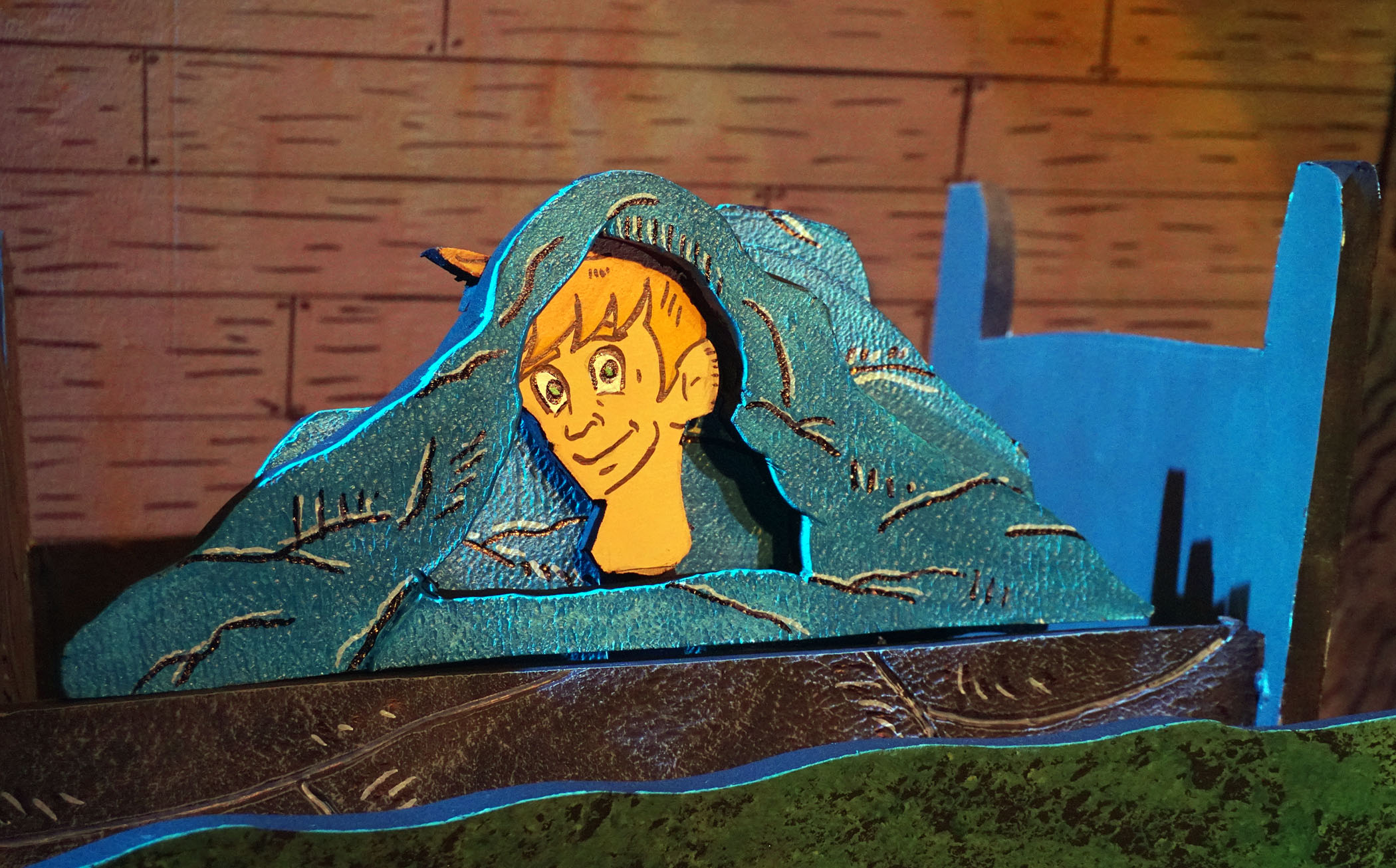
Produced by special arrangement with The Dramatic Publishing Company of Woodstock, Ill., the play will be performed in the style of “Paper Theatre.” Sometimes called Toy Theatre or Model Theatre, this whimsical production style traces its roots back to Europe in the 1800’s. The production takes this form to a grand scale using large puppets and voice acting to tell the story.
Actors manipulate the puppets on a stage built specifically for the production. The puppet theatre action gets recorded on video. The play’s audio gets looped over the video action. The puppet characters use multiple emotional expressions during the play. The characters required seamless design of shape, costume, and color for each scene.
“Since everything stays as movable pieces it should give a really wicked depth,” said Richard Curtis, character designer and set designer for the play. “For the characters we are blending puppet theatre, paper theatre, and stop motion.”
This production marks the return of students to campus to work in the RCPA. As is the long-held standard for Northeast State Theatre, the production pushed students outside their comfort zones.
“It really put us to the test on our theatre skills, and what we learn in class,” said Saqqara Scott, assistant sound designer and assistant scenic designer. “It was my first time working on anything design wise.”
A first-year student at Northeast State, this production marks Scott’s first foray into theatre design. She also helped develop sound elements incorporated into the play. The “sounds” of Wiley range from background music, footsteps, animals, and simple character movements.
“I’ve never been behind the scenes before I’ve always just been acting,” said Scott. “The experience of having all these people trust me to get sound done and help with the set is truly great.”
Mann took on dual roles of assistant character designer and performing as a member of the chorus. He designed the swamp animals that inhabit the swamp near Wiley’s home. A snake, bats, and an alligator are Mann’s handiwork. The key, he said, is keeping the animals recognizable in form but fitting their presence into the play’s action. He worked to give the animal puppets detail while retaining a cartoonish look.
“It has given challenges we’ve never had to face before like making the puppets and making a stage that fits those puppets,” said Mann. “It has given us a lot more work but also given us a lot more opportunities.”
A Northeast State alumnus, Curtis brings a wealth of experience as set designer and character designer for Wiley. He built an elaborate throne of books for the production of The Giver, the 2020 spring semester play cancelled due to COVID.
‘We’ve never done this type of production before,” said Curtis, who is pursuing his master’s degree at Regents University. “We figured if we are going to go, go big.”
A double major in Theatre and Visual Arts, Cheyenne King joined the production as lead costumer designer. An avid cosplayer, costumer design came second nature to King. She jumped when offered the opportunity offered to design costumes for the play.
She collaborated with Curtis to create a base for the characters. Once their visions for the costumes and characters jelled, the character foam frame was heat formed and cut out. The characters’ foam design goes through the heat-forming process to solidify the product. Those designs undergo shaping and painting. King measured the character dimensions to fit all the costumes to mesh with the character’s frame and the set design.
“I took my drawing get it to fit the frame of how the set designer wanted it to look,” said King. “It involved a lot of base coating, repainting things, and going over with Sharpies; which is very different from physically sewing.”
King used various painting mixes to create the costume for each character’s shape. She drew watercolor costume concepts for the Dracula audio production last semester. Like her peers, King wants to see her creations on characters performing on stage in front of a live audience.
“I cannot wait to be do show and physically make costumes,” said King. “I can’t wait to be able to physically make something an actual audience will see.”
King’s enthusiasm represents the feelings of entire industry. Perhaps the most exciting part of the Wiley production is the production process. Students return to the theatre space albeit still socially distanced and masked. The sound of painting, sawing, and laughter once again filled the RCPA theatre and scene shop. The next step forward is a live audience – even a socially distant one – watching a Northeast State Theatre play on stage.
“It is lifting people’s spirits to be able to do something,” said Curtis. “I want to see people back in these seats.”

On a spring afternoon inside the Regional Center for Performing Arts (RCPA) Theatre at Northeast State Community College, the space was alive with sound.
Students were on stage and in the scene shop. Sets were being built and painted. Familiar faces were laying the foundation for a new production.
As COVID swept across the globe in early 2020, theatres went dark. While audiences still cannot fill the seats, Northeast State Theatre team remains committed to educating students and producing strong plays such as the upcoming livestream production of Wiley and the Hairy Man. The play debuts April 22 and continues through April 26. Check the Theatre web page for livestream availability at the theatre web page: https://www.northeaststate.edu/Theatre.
“We are trying to do what we can in the times that we are in,” said Gavin Mann, a second-year student and veteran of multiple Northeast State Theatre productions. “This production is unlike anything I’ve ever done before.”
Set deep within the mysterious Tombigbee Swamp, Wiley and the Hairy Man by Susan Zeder centers around a young boy facing his worst fears that lurk in a nearby swamp. In an exciting duel of wits, Wiley learns to rely upon his own resources and conquers two villains: the Hairy Man and his own fear. Wiley debuts in a virtual viewing format on April 22 and continues through April 26. The audiences stream the show and listen to the actors while watching the story come to life in an imaginative and creative way. Tickets to the live stream are FREE but patrons must reserve a viewing time. The play delivers a warm, imaginative story for the entire family.
The task of bring this detailed production to life falls to theatre professor Elizabeth M. Sloan, the play’s director Brad McKenzie, and a host of dedicated students. A theatre production in the best of times involves many moving parts. Sloan and McKenzie needed to keep the department safe and COVID-free for all. NST delivered a dramatic audio production of Dracula in time for Halloween last fall.
SarahGrace Triplett, a first-year Northeast State students, portrays the character “Dog” voicing. Her first go with Northeast State She also jumped in to assist with sound and lighting design and painting the set. Triplett and other actors recorded their parts in COVID-safe individual sound booths built on the Regional Center for Performing Arts stage.
“Theatre is my thing and it gives me something to look forward to every day,” said Triplett, an alumna of the Barter Theatre Youth Academy.
Produced by special arrangement with The Dramatic Publishing Company of Woodstock, Ill., the play will be performed in the style of “Paper Theatre.” Sometimes called Toy Theatre or Model Theatre, this whimsical production style traces its roots back to Europe in the 1800’s. The production takes this form to a grand scale using large puppets and voice acting to tell the story.
Actors manipulate the puppets on a stage built specifically for the production. The puppet theatre action gets recorded on video. The play’s audio gets looped over the video action. The puppet characters use multiple emotional expressions during the play. The characters required seamless design of shape, costume, and color for each scene.
“Since everything stays as movable pieces it should give a really wicked depth,” said Richard Curtis, character designer and set designer for the play. “For the characters we are blending puppet theatre, paper theatre, and stop motion.”
This production marks the return of students to campus to work in the RCPA. As is the long-held standard for Northeast State Theatre, the production pushed students outside their comfort zones.
“It really put us to the test on our theatre skills, and what we learn in class,” said Saqqara Scott, assistant sound designer and assistant scenic designer. “It was my first time working on anything design wise.”
A first-year student at Northeast State, this production marks Scott’s first foray into theatre design. She also helped develop sound elements incorporated into the play. The “sounds” of Wiley range from background music, footsteps, animals, and simple character movements.
“I’ve never been behind the scenes before I’ve always just been acting,” said Scott. “The experience of having all these people trust me to get sound done and help with the set is truly great.”
Mann took on dual roles of assistant character designer and performing as a member of the chorus. He designed the swamp animals that inhabit the swamp near Wiley’s home. A snake, bats, and an alligator are Mann’s handiwork. The key, he said, is keeping the animals recognizable in form but fitting their presence into the play’s action. He worked to give the animal puppets detail while retaining a cartoonish look.
“It has given challenges we’ve never had to face before like making the puppets and making a stage that fits those puppets,” said Mann. “It has given us a lot more work but also given us a lot more opportunities.”
A Northeast State alumnus, Curtis brings a wealth of experience as set designer and character designer for Wiley. He built an elaborate throne of books for the production of The Giver, the 2020 spring semester play cancelled due to COVID.
‘We’ve never done this type of production before,” said Curtis, who is pursuing his master’s degree at Regents University. “We figured if we are going to go, go big.”
A double major in Theatre and Visual Arts, Cheyenne King joined the production as lead costumer designer. An avid cosplayer, costumer design came second nature to King. She jumped when offered the opportunity offered to design costumes for the play.
She collaborated with Curtis to create a base for the characters. Once their visions for the costumes and characters jelled, the character foam frame was heat formed and cut out. The characters’ foam design goes through the heat-forming process to solidify the product. Those designs undergo shaping and painting. King measured the character dimensions to fit all the costumes to mesh with the character’s frame and the set design.
“I took my drawing get it to fit the frame of how the set designer wanted it to look,” said King. “It involved a lot of base coating, repainting things, and going over with Sharpies; which is very different from physically sewing.”
King used various painting mixes to create the costume for each character’s shape. She drew watercolor costume concepts for the Dracula audio production last semester. Like her peers, King wants to see her creations on characters performing on stage in front of a live audience.
“I cannot wait to be do show and physically make costumes,” said King. “I can’t wait to be able to physically make something an actual audience will see.”
King’s enthusiasm represents the feelings of entire industry. Perhaps the most exciting part of the Wiley production is the production process. Students return to the theatre space albeit still socially distanced and masked. The sound of painting, sawing, and laughter once again filled the RCPA theatre and scene shop. The next step forward is a live audience – even a socially distant one – watching a Northeast State Theatre play on stage.
“It is lifting people’s spirits to be able to do something,” said Curtis. “I want to see people back in these seats.”
Share this:
Like this: